School News – 10/5/2022

School News – 10/5/2022


Welcome Back!

Thank you all for a wonderful first Quarter! We are looking forward to a fun and busy Quarter two, full of learning and activities! Here are the highlights to look forward to:


October is also National Principals month! We are so thankful for our Headmasters and Assistant Headmasters. Be on the lookout for Headmaster Spotlights on Facebook to learn more about our spectacular school leaders!


A Pledge for Life

Students of Classical Charter Schools of America recite the Pledge daily after the Pledge of Allegiance. The Pledge is not only for school but is a Pledge for life! It encapsulates the true meaning of what a life well-lived should represent. Classical education centers on wisdom and virtue and these tenets are at the heart of the Pledge. One portion of the Pledge encourages us all to think for ourselves and not rely solely on experts or “popular opinion and custom,” something that is of the utmost importance in a world filled with conflicting information and free-for-all journalism.  The third verse of the Pledge captures the meaning of virtue. Students pledge to have faith and hope, as well as charity toward their neighbor. Students also pledge to be just and prudent. They pledge to have fortitude and temperance.  We should all aspire to the principles ascribed in the Pledge. Following it will lead us to a better society where truth and goodness prevail.  Please click on the link below to read the Pledge in its entirety.

The School Pledge


Students of the Month

Character education is an important part of the CCS-America curriculum. Each month, students are recognized for displaying a specific character trait that they are not only learning and practicing, but also recite daily in our Pledge. September’s character trait was Loyalty. Students who are loyal show commitment, even in difficult times. Loyalty is seen in the Pledge as “I Pledge to be obedient and loyal to those in authority.” Students apply these words to their everyday lives by keeping their commitments, helping those in need, and caring about others. Congratulations to all of these students who demonstrated exemplary loyalty. Check them out on the links below!

CCS-Leland

CCS-Whiteville

CCS-Wilmington


School News – 9/21/2022

School News – 9/21/2022

Shakespearean Shenanigans

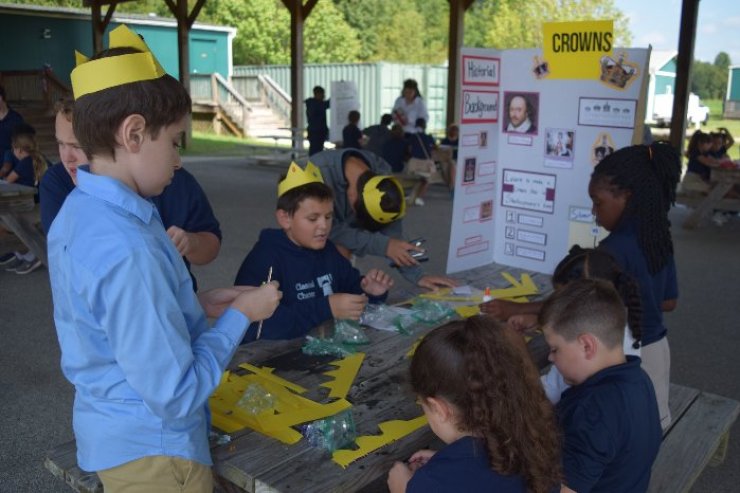
CCS-America celebrated its annual Shakespeare Week with a variety of activities. Celebrations included a performance by a court jester from No Sleeves Magic, an informational presentation from Cape Fear Raptor Center on falconry, ballet lessons, archery demonstrations, and more! Students in K-5 read grade-level-adapted Shakespearean plays and made crafts corresponding with their play. Students in grades 6-8 read several famous Shakespearean plays in their entirety: Julius Caesar (6th), Macbeth (7th), and The Tempest (8th). Some middle school classes prepared a Shakespeare Showcase featuring different aspects of life during the 1600s and gave presentations to elementary classrooms. All students and staff learned and celebrated the life of the greatest writer in the history of the English language, William Shakespeare! Learn more about the life of William Shakespeare below.

The Life of William Shakespeare


Alumni Spotlight

Meet Abigail Bowen from Classical Charter Schools of Whiteville’s graduating class of 2015. Ms. Bowen has returned to CCS-Whiteville as an employee! Learn more about Ms. Bowen here!


We the People of the United States of America

The true power in our nation’s government resides in the first three words of the Constitution, “We the People”. Students of CCS-America observed Constitution Day on September 16, commemorating the signing of the U.S. Constitution on September 17, 1787. Students celebrated by participating in a parade and learning about the importance of the Constitution through different activities: Escape Rooms, videos, books, crafts, and more. Each student received an American flag (made in the USA) to wave while marching in the parade to patriotic music. All campuses were visited by the Father of the Constitution, James Madison! James Madison gave a speech and then joined the students on the parade route. At CCS-America we hope ALL American citizens know and value the US Constitution. Click on the links below to read the Constitution and learn more about the Father of the Constitution, James Madison.

The Constitution of the United States of America

James Madison 


N.C. Charter School Operator Petitions Supreme Court

N.C. Charter School Operator Petitions Supreme Court

For the full PETITION FOR A WRIT OF CERTIORARI – Click Here

N.C. Charter School Operator Petitions Supreme Court
To Reverse Appellate Court Ruling That
“Profoundly Threatens” America’s Charter Schools

WASHINGTON, DC, Sept. 12, 2022—Charter Day School, Inc., a North Carolina charter school operator that has been criticized by activist organizations because of its student uniform policy, asked the Supreme Court today to “review and reverse” a recent appeals court ruling holding the policy unlawful. The 10-6 ruling by the Fourth Circuit Court of Appeals in Richmond was issued June 14.

The organization’s “Petition for a Writ of Certiorari” is based on the Fourth Circuit’s finding that the private non-profit charter school operator is a “state actor” and, in the court’s opinion, bound by the rules and regulations that control government-run public schools. Charter Day School, Inc., maintains that the Fourth Circuit ruling is flawed, running counter to long-standing analogous state-action rulings by both the Supreme Court and three federal appellate courts.

“North Carolina charter schools—like many throughout the Nation—build upon a critical insight: Allowing private entities to operate publicly funded schools with minimal government oversight supercharges educational innovation and expands parental choice.

“The [court of appeals] decision … profoundly threatens this model,” Charter Day School, Inc. officials say, by declaring that the private educational corporations that run charter schools—along with their volunteer boards—are “state actors subject to suit under 42 U.S.C. 1983 [which allows individuals to sue for alleged constitutional violations], even for policies they design with no government input whatsoever. This holding undoes the central feature of charter schools by treating their private operators as the constitutional equivalent of government-run schools.”

Citing Fourth Circuit Judge A. Marvin Quattlebaum, Jr., one of six dissenters in the June 14 ruling, the school notes that prior to the June 14 decision “neither the Supreme Court nor any federal appellate court” had ever concluded that a publicly funded charter school is a state actor under 42 U.S.C. 1983. Indeed, following Supreme Court guidance in analogous cases, “the First, Third and Ninth Circuits have all held that a private education contractor does not engage in state action, unless the state coerced or encouraged the challenged conduct.”

Classical Charter Schools of America

Charter Day School, Inc.’s petition argues that the Fourth Circuit ignored the prior rulings that addressed “the same or very similar issues” and reached the opposite conclusion. The petition also takes strong issue with the Fourth Circuit’s finding that “providing education is a traditionally exclusive state function—like holding elections or exercising eminent domain—despite centuries of evidence to the contrary.” This finding appears to have been based not on any actual provision in North Carolina law, but on the fact that charter schools typically are called ‘public charter schools.’

The petition for certiorari stresses that far more is at stake than the school’s “parent-designed” school-uniform policy, requiring girls to wear skirts, jumpers or skorts (shorts that look like skirts), which most activists and journalists have focused on. “The Fourth Circuit’s rationale lacks meaningful ‘limiting principles’ and would cover charter-school operators throughout the country,” school officials warn. This would threaten the independence of such schools and, as Fourth Circuit Judge J. Harvie Wilkinson III warned in his dissent, “send … education in a monolithic direction, stifling the competition” that spurs educational improvement.

BACKGROUND

The North Carolina Charter School Act, enacted in 1996, aims to “improve student learning” and “encourage the use of different and innovative teaching methods.” The goal is to “provide parents and students with expanded choices” in “educational opportunities.” The statute deems charter schools to be “public schools” in the sense that they are open to all, tuition-free, and receive state funding for each student that enrolls. The similarities with government-run public schools “end there,” the Charter Day School, Inc. petition stresses.

North Carolina gives charter-school operators wide discretion to devise educational policies, free of government interference. Indeed, the Charter School Act states clearly that charter schools “operate independently of existing schools” and are “exempt from statutes and rules applicable to a local [governmental] board of education.”

Charter Day School, Inc., founded in 1999, is located in Leland, NC, near Wilmington, and holds the charters for four schools now known as the Classical Charter Schools of America (CCS-America). The original school in Leland currently enrolls nearly 1,000 students in kindergarten through eighth grade. The three other CCS-America schools, in downtown Wilmington, Whiteville, NC, and Southport, NC, enroll approximately 1,700 additional students. All four are Title 1 schools, serving high proportions of low-income students, and outperform most of the district schools in the areas they serve. The schools stress traditional values, such as truthfulness and respect, and use a classical curriculum and proven teaching methods, such as phonics-based reading instruction, grammar lessons beginning in kindergarten, and teaching history chronologically, starting in first grade. Students study Latin beginning in fourth grade.

-END-


School News – 9/7/2022

School News – 9/7/2022

Archery: On Target for Life

Did you know that CCS-America offers our students the opportunity to shoot target archery in school? Since 2010, our schools have competed in the National Archery in Schools Program (NASP), which has put bows in the hands of over 18 million students nationwide! Target archery improves students’ educational performance by enhancing their focus and concentration, leading to noticeable improvements in attention and behavior. Many NASP schools also find that their archery programs build confidence and self-esteem, and help students become more connected with their school. In the 12 years we have participated, we have captured eight state championships, two second place finishes, and countless CCS-America students have been recognized as top shooter in their grade, and even top in the state! Stay tuned for more CCS-America archery information throughout the year!

NASP


Students of the Month

Character education is an important part of the CCS-America curriculum. Each month, students are recognized for displaying a specific character trait that they are not only learning and practicing, but also recite daily in our Pledge. August’s character trait was Responsibility. Students who are responsible take ownership of their thoughts, words, and actions. Responsibility is seen in the Pledge as “I Pledge to keep myself healthy in body, mind, and spirit.” Students apply these words to their everyday lives by taking care of themselves, doing their best, and fulfilling their duties. Congratulations to all of these students who demonstrated exemplary responsibility. Check them out on the links below!

CCS-Leland

CCS-Southport

CCS-Whiteville

CCS-Wilmington


Staff Spotlight

Meet CCS-Leland 8th Grade Teacher, Ms. Katy Bannerman!  


School News – 08/24/2022

School News – 08/24/2022

RBA’s Three Laws: A True Trifecta

The Roger Bacon Academy’s Three Laws guide our schools and students to excellence, a true trifecta! Law 1: Reward good behavior – you’ll get more of it. Students are rewarded for good penmanship, correct answers, being in proper uniform, showing respect and courtesy, and other attributes. This law lays the foundation for the other laws. Giving students specific praise and rewarding them encourages other students to be virtuous as well. Displaying virtue may be rewarded tangibly with tickets, treasure box items, or stickers, and verbally with praise, approval, gratitude, or privileges. Law 1 of rewarding good behavior teaches students to display virtue in all situations leading to a more successful and rewarding life. Law 2: Teach to mastery – every child will learn. We strive to meet each student’s achievement level and teach them from that point forward. This is possible through our curated curricula. If students are advanced, they are able to begin above grade-level classes starting in kindergarten. Likewise, if they needs extra support, they are taught at the level that meets their needs. In a regular public-school setting, all students are taught on the same level. Such a model does not offer growth or acceleration but provides stagnation. Our family of schools fosters mastery by challenging students and encouraging their success.   Law 3: Watch the children – If they are not learning or behaving properly, the first two laws are not being followed. If students are rewarded for good behavior and are provided with the appropriate learning material to challenge them, they will behave and learn in the classroom. If students are misbehaving, they could be lacking reinforcement and/or the learning material could be too easy or too difficult, resulting in inappropriate behavior and the lack of academic success. Our teachers are taught to defer to the first two laws when this occurs. These time-tested, field-proven laws set the tone for our schools’ learning environment and mission and pave the way for our students’ success as seen in our successful alumni. Find out more about our three laws with their references by clicking the link below:

Our Three Laws- What, How, and Why


Alumni Spotlight

Meet Christy Woodburn from the first RBA graduating class of 2007! Mrs. Woodburn owns and operates Greatest Potential Chiropractic in Leland, NC. Learn more about Mrs. Woodburn and how she still uses the Pledge in her daily life here!


Who is Roger Bacon?

The Academy is dedicated to the principles espoused by Roger Bacon (1214-1292). Professor Bacon was a devoted thinker and is credited with originating the “scientific method” and thus being the first modern scientist. Roger Bacon desired to become a teacher. He attended Oxford University; and after obtaining his degree, he became a teacher at University of Paris. Bacon studied and taught Aristotle’s writings and believed Aristotle was a great thinker. But after attempting experiments based on Aristotle’s writings, Bacon discovered that many of the findings were incorrect. Bacon was disappointed, having wasted so much effort on the incorrect teachings. Because of this, Bacon devised a systematic way of judging whether a statement was true or false, thereby leading to trustworthy knowledge. Roger Bacon was a man whose source of greatness- his determination to always seek truth- is seeded within every one of us. We all have the ability to achieve the same greatness as Bacon, and with our own self-determination we will seek truth in the universe.

Roger Bacon